7 Sideline Etiquette Tips for Sports Parents, Part 2 of 6

WHY I WROTE THIS SIX-PART SERIES: LESS FRAZZLED, MORE FOCUSED- A CLUB SEASON SURVIVAL GUIDE: When your season starts, it can be a lot—mentally, emotionally, logistically. Whether you’re brand new to the club scene or on season seven, the chaos hits hard and often. I created this six-part series- a sports moms survival guide to offer a little more clarity, a little less comparison, and a few real tools to feel less overwhelmed and more present. Because we all want the same thing:
To support our athletes without losing our minds in the process.
A Club Season Survival Post for Sports Moms Who Mean Well (and Sometimes Yell)
Let’s be honest—we’ve all done it. We crossed the Sideline Boundaries.
You’re deep into tournament play.
There’s pressure. There’s bracket tension. There’s That One Coach pacing with a clipboard.
And suddenly, you hear yourself shouting: You forgot the sideline etiquette.
“Rotate!”
You don’t want to be That Mom.
But here you are. Bleacher row five. Other parents give you the side eye.
You’re channeling your inner assistant coach while your athlete avoids eye contact.
It’s okay. This post isn’t about shame.
It’s about boundaries.
The kind that help you support your athlete without coaching them from the stands.
Why Your Sideline Etiquette Is Important
You are already doing so much for your athlete:
The rides. The gear. The schedule coordination. The emotional debriefs. The snack runs. The snack re-runs.
But when we start coaching from the bleachers—no matter how well-intentioned—it can pile on pressure instead of support.
Especially in those moments when our athletes are already trying to:
- Earn playing time
- Navigate tough rotations
- Or quietly prove their worth to a college scout (and believe me, scouts watch YOU too)
So here’s how to stay present, encouraging, and… a little less shouty.
There’s a sort of unspoken sideline etiquette you start to pick up after a few seasons.
It’s not in the handbook. But it matters.
Because when the parents keep their cool, the whole environment shifts—for the athletes and the team culture.
And let’s be honest…
I’m willing to bet the parents who just watched their girls at Texas A&M win the D1 National Championship didn’t yell “Talk” from the bleachers.
Jaime Morrison has that covered. 😏
So for the rest of you about to hit club season in full swing after the holidays—here’s a quick reminder:
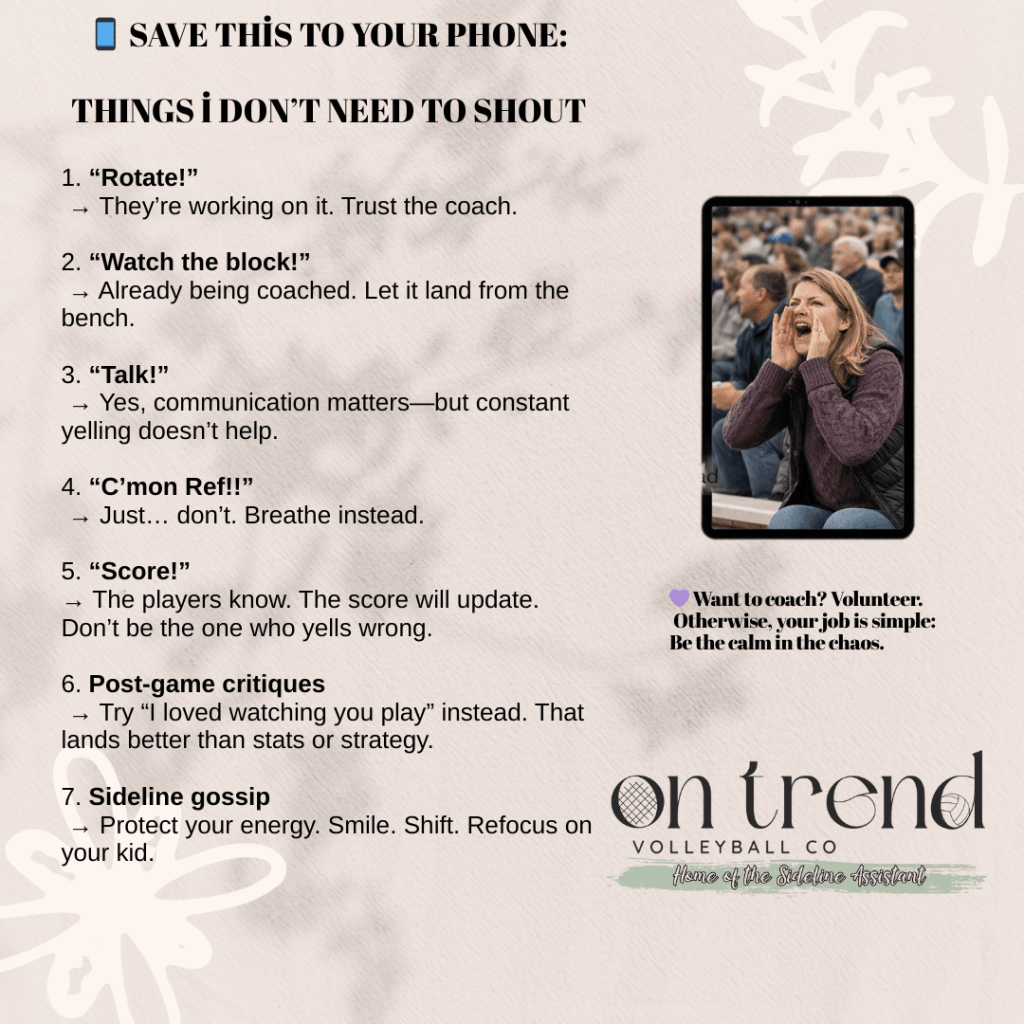
🏐 SIDELINE SELF-CHECK: 7 Things You Don’t Need to Say (Even if You Want To)
1. “Rotate!”
They know. The coach knows. The scoreboard will figure it out.
You’re not wrong—but you’re also not the one running rotations.
2. “Watch the block!”
Solid advice… that the bench already gave three times.
Let it land from the coach, not from mom in Row 3.
3. “Talk!”
Communication matters, yes.
But yelling it every play isn’t helping. It just adds to the noise.
4. “C’mon Ref!”
Breathe. Sip. Don’t get yellow-carded.
5. “Score!”
The players are tracking it.
You yelling probably won’t change it—and being wrong is worse.
6. Sideline gossip in general
Someone will always want to talk drama—team levels, who moved up, who shouldn’t have.
Protect your peace. Shift the convo. Focus on your kid.
7. Critiques on the car ride home
The post-game breakdown isn’t your job.
Try this instead:
“I loved watching you play.” “How did that feel?”
It lands better than any stat critique ever could.
💜 Real Talk
You’re not wrong for noticing what’s happening on the court.
You’re invested. You care. You want your kid to grow, level up, be seen.
And when something goes sideways in rotation—or that one girl who never calls the ball misses again—it’s hard not to say something.
But here’s the thing: your athlete already has a coach.
Your job?
Show up.
Cheer loud and positively for the entire team.
Stay grounded.
And let the lineup run its course—without the sideline strategy session.
✋ SIDELINE SELF-CHECK
Right click and save this to your phone ⬇️