
The Post-Game Ride Home: How to Talk to Your Athlete After a Tough Match

WHY I WROTE THIS SIX-PART SERIES: LESS FRAZZLED, MORE FOCUSED- A CLUB SEASON SURVIVAL GUIDE: When your season starts, it can be a lot—mentally, emotionally, logistically. Whether you’re brand new to the club scene or on season seven, the chaos hits hard and often. I created this six-part series- a sports moms survival guide to offer a little more clarity, a little less comparison, and a few real tools to feel less overwhelmed and more present. Because we all want the same thing:
To support our athletes without losing our minds in the process.
For many club volleyball parents, the ride home after a game can feel harder than the match itself.
There’s something sacred—and slightly dangerous—about the post-game ride.
You’re holding your water bottle.
Your athlete is holding their emotions.
And everyone is holding back words they probably shouldn’t say yet.
You want to ask what happened.
You want to encourage.
You might even want to casually slip in, “You know, if you’d stayed lower on defense…”
But the post-game conversation with your athlete isn’t about performance.
It’s about recovery.
And sometimes recovery looks like silence, snacks, music, or just letting the emotional dust settle.
Why the Ride Home Matters
Your athlete is still processing—physically, mentally, emotionally.
Especially if:
- They didn’t play the way they hoped
- They sat more than expected
- The match was intense or close
- They made a mistake they can’t stop replaying
How we handle the ride home after a game matters—especially in club volleyball, where emotions and expectations run high.
And there’s something about volleyball that makes this even harder to explain.
My daughter was a gymnast before she played volleyball, and that was a different kind of pressure. I was nervous then too—but volleyball brings this emotional buildup followed by either a big letdown or an intense exhilaration. Sometimes both in the same match.
Momentum shifts fast.
Points matter immediately.
One play can change the entire energy of the gym.
Those feelings are a big deal—especially for new club players and parents trying to navigate all of it for the first time.
By the time your athlete gets in the car, they’ve already been through a lot.
So before the questions come out, here are a few ways to make that ride a reset instead of a replay.
🚙 Mindful Ride-Home Tips for Sports Parents
1. Read the room (aka the car)
If they get in silent, let them be.
If they toss off their shoes and say, “That was awful,” try responding with:
“Yeah… that was a tough one.”
And then stop.
Know what kind of kid you have and how they respond to pressure.
Some athletes want to talk right away.
Others need space—especially after an intense match.
My player?
After a five-set battle, she used to get in the car still shaking—amped up, emotionally drained, holding the match in her body.
Guess what? She still does this after college matches.
Unless it was a win, the last thing she wants to do is relive it.
So resist leading with:
“So… what happened?”
They already know.
They felt it.
2. Ask if they want to talk—not what went wrong
Try:
“Do you want to vent, or do you just want to chill for a bit?”
That one sentence gives them control—and tells them you’re there either way.
3. Praise effort, not outcome
They already know the mistakes.
What lands better is noticing who they were in the moment:
“I loved your hustle.”
“You stayed composed when things got messy.”
Character sticks longer than stats.
4. Let food or music do the talking
Sometimes the most supportive thing you can say is:
“Where do you want to eat?”
Or letting them control the playlist.
Snacks > strategy.
5. Your past doesn’t make this a review session
It doesn’t matter if you played.
It doesn’t matter if you coached.
It doesn’t matter if you definitely know what went wrong.
The ride home is not the place to break it down.
And please don’t spend time blaming another athlete on the team for a loss. Clearly, your daughter or son has chosen a team sport where responsibility is shared.
6. Know when not to bring it up later
If they’ve moved on, let it go.
They’re already replaying it in their head.
Your silence says:
“I’ve got you. We’re good.”
Real Talk
The post-game ride doesn’t need to be tense.
It doesn’t need to be awkward.
And it definitely doesn’t need to turn into a performance review.
Sometimes the best thing you can give your athlete is a calm place to land.
You’re not just their ride.
You’re their reset.
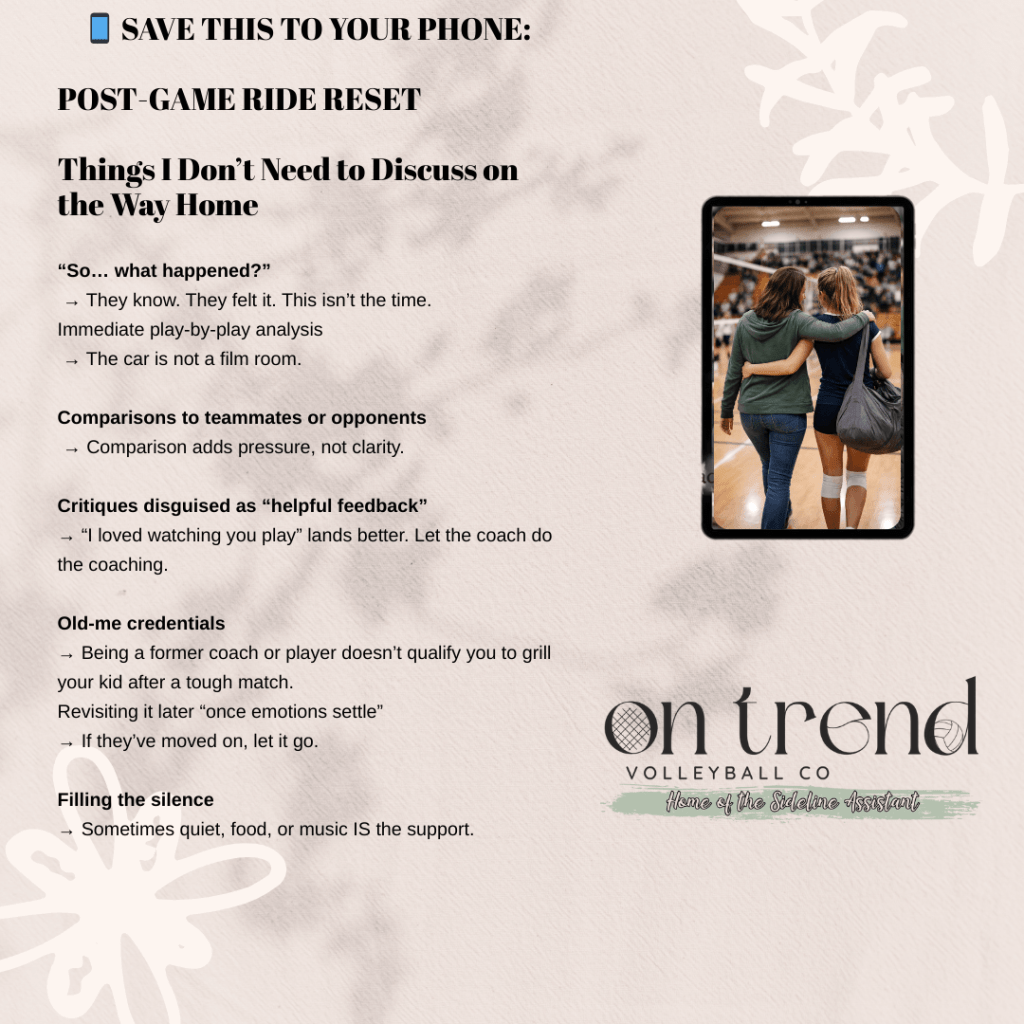
Right click and save the reminder graphic below ⬇️
Catch Up on the Series
If you missed the earlier posts in this series, you can catch up here:
Part 1: Breathe, Mom — Staying Present During the Chaos of Club Season
Part 2: Sideline Boundaries — How to Support Your Athlete Without Over-Coaching